Why Joshua's Median Home Price Depends on Which Website You're Reading
Ask five real estate sites what a home costs in Joshua, Texas right now, and you'll get five different answers. Pull them up side by side and the range isn't a rounding error. It spans well over a hundred thousand dollars, from a home value estimate in the mid $300,000s to an active-listing median north of $460,000. Nobody's numbers are wrong. They're measuring different things, and the reason they disagree tells you more about the Joshua market than any single figure could.
If you're comparing Joshua to Burleson, or trying to figure out what your budget actually buys eight miles apart on Highway 174, the disagreement between these numbers is the story, not a distraction from it.
Here's what a snapshot of Joshua pricing looks like when you line up the sources side by side.
| Source and time window | Figure | What it's actually measuring |
|---|---|---|
| Portal active listings, August 2026 | $463,000 median list price | Homes currently for sale, asking price only |
| Trailing 12 months of closed sales, mid-2026 | $384,990 median sale price | Homes that already sold and closed |
| Census estimates, 2019-2023 | $350,716 median home value | A multi-year average across all owner-occupied housing, new and old |
| A separate portal's current inventory scan | $369,900 median list price | A different slice of active listings, same zip code |
The active-listing figure and the closed-sales figure alone are $78,000 apart. That gap exists because they're not describing the same houses. The active-listing median counts everything sitting on the market right now, including new-construction homes still waiting for a buyer. The closed-sales median only counts what actually sold in the last year, which skews toward homes priced to move.
Days-on-market tells the same story from a different angle. One reading puts the trailing-12-month average at 77 days, a bit slower than the national pace of 56 days but not dramatically so. Another, looking only at what's actively listed in August 2026, puts the median at 239 days on market, even after a 28 percent year-over-year improvement. A home that's been sitting since spring is still "on the market" when a portal takes its snapshot. A home that sold in three weeks already left the dataset. Average those two populations together and you get a number that describes neither one accurately.
The reason these numbers pull apart isn't methodology alone. It's that Joshua's housing stock is genuinely bifurcated, and has been for about a decade.
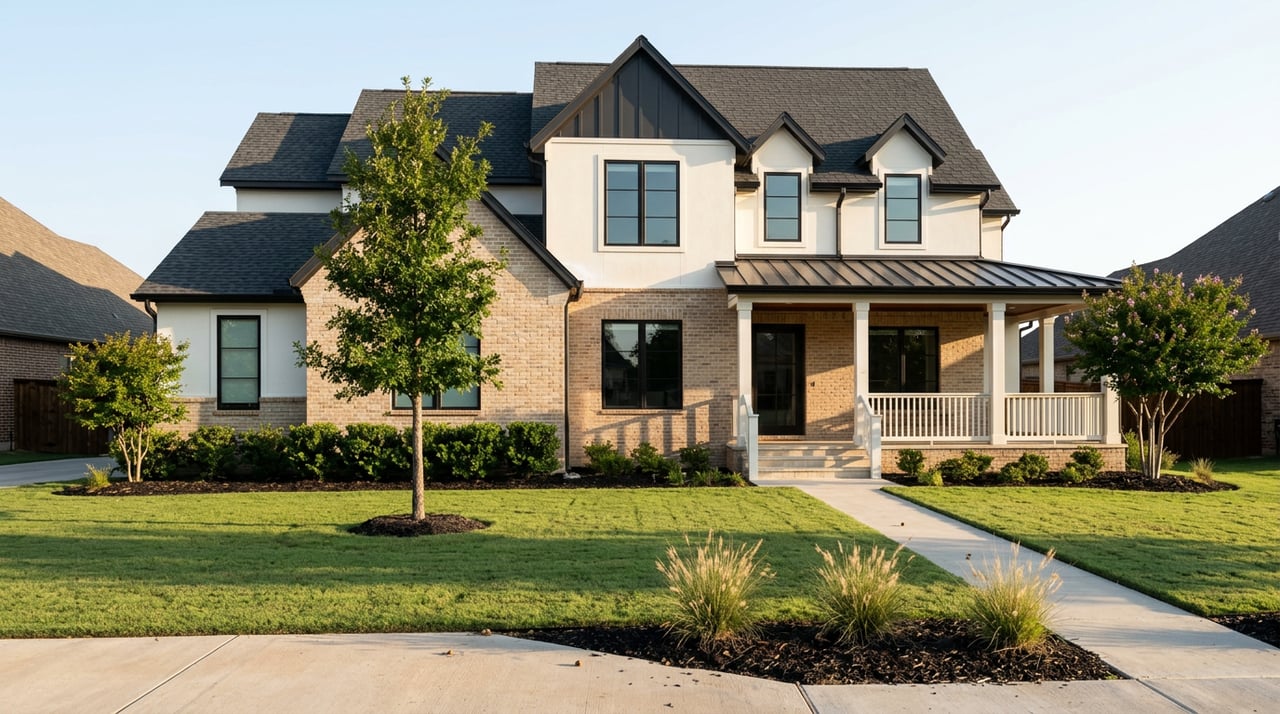
On one end, new master-planned communities are selling at a different price tier than the rest of the city. Joshua Meadows, one of the newer communities, has new construction priced between $550,000 and $640,000. Chesmar Homes completed a 2,597-square-foot plan in Silo Mills, zoned to Godley ISD, this past June. Bloomfield Homes is building in Mockingbird Hills. These are recent, larger, amenity-heavy homes, and they're pulling every citywide average upward.
On the other end sits the legacy stock: homes built in the 1980s and 90s, smaller lots, and a meaningful supply of manufactured homes and small acreage tracts that never show up in a "median home price" headline but make up a real share of what's actually for sale. One data aggregator's snapshot of recently sold homes in the 76058 zip code ranged from $146,815 to $611,603. That's not a market with one center of gravity. That's two markets sharing a zip code.
This matters if you're shopping with a single number in your head. A buyer comparing "Joshua's median" to "Burleson's median" is often comparing a brand-new four-bedroom in a master-planned subdivision against a three-decade-old home on an established street, without realizing the two numbers never described comparable houses in the first place.
For context, Joshua's citywide median still runs below the broader Dallas-Fort Worth median, which real estate research tied to Texas A&M's Texas Real Estate Research Center has placed near $399,000. Joshua is not an expensive outlier in the metro. It's a city where the cheap end and the expensive end are both real, and the average between them means less than the two extremes.
The bifurcation explains why the numbers disagree. It doesn't fully explain why Joshua has been growing at all, or why the gap with Burleson keeps narrowing.
That part comes down to the Chisholm Trail Parkway. Before the toll road, Joshua's distance from downtown Fort Worth, about 25 miles down Highway 174, meant a real commute, close to an hour each way for anyone working north of the city. The parkway cut that drive to something closer to 20 to 30 minutes, and Joshua's population has grown by roughly a third since 2010 as a direct result. That's not a coincidence of timing. It's the mechanism.
A commute cut in half doesn't just add convenience. It rewrites which zip codes compete with which other zip codes for the same buyer.
Once Joshua stopped being an hour from Fort Worth and started being half an hour, it stopped competing only with other small Johnson County towns and started competing directly with Burleson for the same commuting buyer. Cost-of-living data reflects that shift already underway: Burleson runs a cost-of-living index of 109, about 1.1 times Joshua's, while Joshua sits closer to the middle of the pack regionally. Burleson's own housing market shows signs of softening in the same window, with average home values down 2.7 percent year over year as of May 2026 and homes going to pending in around 46 days. Joshua isn't catching up because Burleson is struggling. It's catching up because the commute math that used to justify a lower price in Joshua no longer holds the way it did five years ago.
Main Street still looks different between the two towns. Joshua's local dining runs to a handful of independent restaurants and a coffee shop downtown, with chain options along Highway 174 and a wider selection eight miles north in Burleson. That gap in day-to-day amenities is real, and it's part of what still separates the two markets even as the commute gap has closed.
Is Joshua cheaper than Burleson? It depends which slice of each market you're comparing. Citywide averages put Joshua below Burleson, but new construction in Joshua's master-planned communities can run higher than comparable homes in established Burleson neighborhoods. Legacy homes and acreage in Joshua remain the more affordable end of the comparison.
Why do real estate websites disagree so much on Joshua's numbers? Because they're measuring different populations of homes. Active-listing medians count what's for sale right now, including slower-moving new construction. Closed-sales medians only count what already sold. Census-based home value estimates average multiple years of ownership across the entire housing stock. All three are accurate. None of them are describing the same set of houses.
Has the Chisholm Trail Parkway actually changed prices, or just perception? Both. The population growth and the narrowing cost-of-living gap with Burleson are measurable outcomes, not just a feeling. A shorter commute changed who considers Joshua a viable place to live, and that shift in buyer pool shows up in the data.
If you're trying to figure out what your specific budget actually buys in Joshua versus Burleson, or which side of that price split makes sense for your family, a citywide average isn't going to answer it. Schedule a Free Home Valuation with Joy Michelle Realty Group and get a comparison built on the actual streets and subdivisions you're considering, not a five-website average of homes you'll never walk through.
Stay up to date on the latest real estate trends.
For more than 30 years we have dedicated 150% to providing exceptional customer service with great care, diligence, and compassion. One of our main goals is to make your process as enjoyable and seamless as possible.